


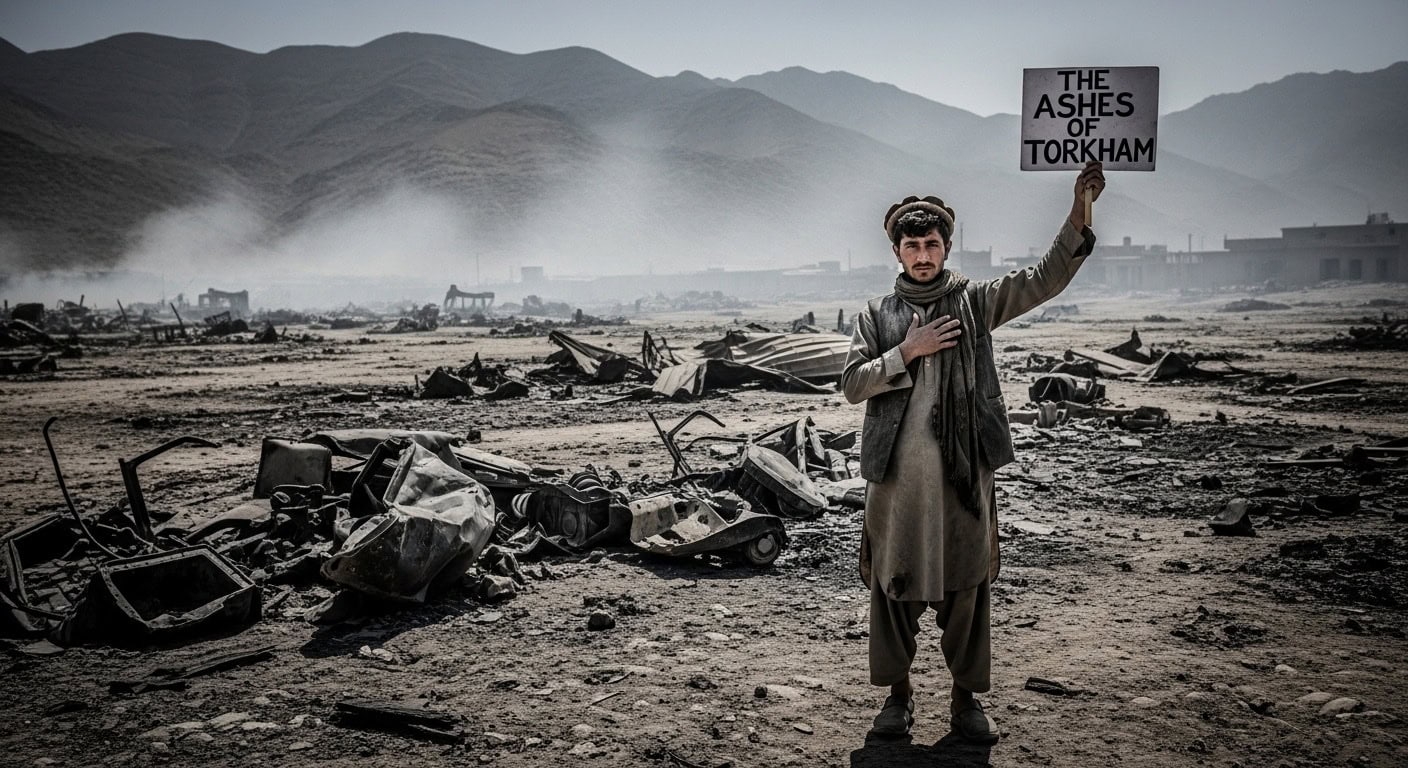
Picture a bustling marketplace just before dawn. On March 7th, at around 4:00 AM, a roaring fire consumed over 150 shops at the Torkham border market on the Afghan side. Close your eyes for a second and imagine the sheer human devastation. An estimated 300 million Afghanis’ worth of livelihoods, representing generations of hard work, were reduced to smouldering ash in mere hours. Who did that? Who was responsible?
As I watched footage of thick smoke rising into the sky, a chilling yet completely logical question lingered in my mind: Who actually set that fire?
The Afghan Taliban immediately pointed fingers at Pakistani security forces. But let us step back and look at a map, shall we? The Torkham bazaar sits comfortably about two kilometres away from the nearest Afghan military border post. When Pakistani forces actively engage military targets to defend our borders, how does a bustling civilian market miles away from the engagement point magically erupt in flames? Let us be deeply honest here. It simply does not add up.
What actually does make sense are the murmurs coming from local Afghan traders. These are regular, hardworking people whose lives have just been ruined. Eyewitnesses reported unusual, highly suspicious movements by armed Taliban personnel in the marketplace just before the inferno broke out. Even stranger was the bizarre lack of urgency to put out the fire. A market of that magnitude requires a massive and immediate emergency response. Instead, it was simply left to burn for hours.
There is undeniable and documented evidence that Taliban militants were actively using the civilian population and the market as a human shield by firing upon Pakistani posts from within the bazaar. But why let the whole place burn to the ground? When the Afghan interim government faces mounting internal pressure and massive political failures, it relies on a very old and very tired strategy: playing the victim card. By orchestrating, or at least enabling this fire, they sought to manufacture a false narrative of Pakistani aggression for global sympathy. Tragically, it was the Afghan public who were sacrificed on the altar of the political theatre created by the Taliban.
Yet, amidst the pungent smell of smoke and cheap deception across the border, there are still voices on our own side clutching at the fading straws of appeasement. On March 8th, the Information Minister of Khyber Pakhtunkhwa publicly suggested that dialogue and tribal jirgas are the best way out of this escalating conflict.
Are we seriously doing this again? I really have to ask you: have we learned absolutely nothing from our bloody, utterly failed history of negotiations?
Since 2021, Pakistan has gone out of its way to establish a peaceful rapport. Think back to November 2021, when our government, in a baffling display of optimism, released over a hundred highly dangerous terrorists from provincial jails purely as a goodwill gesture. Or look back at May 2022, when a high-ranking Pakistani delegation sat down in Kabul with the very Tehreek e Taliban Pakistan leadership who were actively plotting our demise.
Over the last few years, we saw repeated ceasefires. We sent Jirgas representing the Mehsud tribes and the Malakand division. We even sent highly respected religious figures, like Maulana Fazlur Rehman and Mufti Taqi Usmani, to Kabul time and again, hoping our shared faith would somehow translate into shared peace.
And what exactly was our reward? Our olive branches were merely used as kindling to burn the writ of our state.
These extremist factions did not use the dialogue process to find peace. They used our temporary ceasefires in Khost and Doha merely to buy time, regroup, recruit, and subsequently launch heavier and deadlier strikes on Pakistani soil. They audaciously used these talks to demand unconstitutional absurdities, such as reversing the FATA merger, while trying to blackmail our nation into granting them autonomous sanctuaries.
I do not know about you, but I deeply believe we have shed far too much innocent blood to continue carrying the heavy burden of our politicians’ past ineptitude.
This is exactly why the current military reality on the ground is not just necessary but absolutely vital for our national survival. Facing constant cross-border terrorism actively facilitated by the Afghan Taliban, Pakistan has finally invoked its sovereign right to self-defence.
On February 26, 2026, Pakistan decisively launched Operation Ghazab Lil Haq. Fast forward to today, and the reality along the border between Pakistan and Afghanistan is one of unapologetic operational dominance by the Armed Forces of Pakistan. This is a highly surgical and necessary campaign to eliminate the safe havens of the Fitna al Khawarij. We are not negotiating with terror anymore. We are dismantling it root and branch. From completely neutralising the Taliban’s Lawara 1 post to capturing the Gudwana Enclave in the Zhob Sector, over 65 hostile staging grounds have been hit hard.
The casualty figures are staggering but very telling. Over 580 hostile combatants have been eliminated, nearly 250 check posts have been demolished, and massive blows have been dealt to their infrastructure. Despite the severe battlefield thrashing, the Taliban propaganda network predictably continues to spit out fabricated and face-saving lies.
So, where do we go from here?
As an everyday citizen who is thoroughly exhausted by watching our homeland bleed while waiting for an elusive diplomatic miracle, I am relieved. Pakistan’s stance must remain absolute from here on out. Terrorism and safe havens must be totally eradicated from Afghan soil. Operation Ghazab Lil Haq must continue until every ounce of hostile intent is permanently snuffed out.
The burning Torkham market is undeniably a massive human tragedy, but it holds a grim lesson for the entire region. The Afghan authorities arrogantly chose to play with fire by using innocent lives to fuel their proxy wars. And now, the fire is finally coming back around for them.
