


Aurangzeb warns oil price surge could raise Pakistan’s monthly import bill by up to $600m, pressuring external account
Petroleum Minister Ali Pervaiz Malik has said that three petrol cargoes were expected to reach Pakistan by Monday, as Middle East tensions threaten fuel supplies across the country.
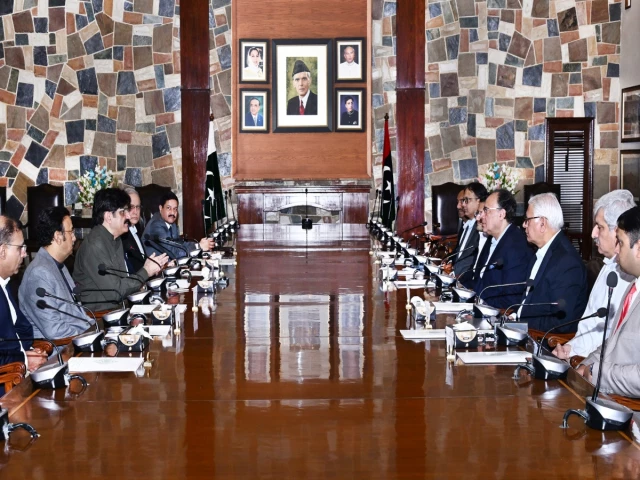
Sindh Chief Minister (CM) Murad Ali Shah met Finance Minister Muhammad Aurangzeb and Petroleum Minister Malik to review the evolving regional situation and its potential impact on Pakistan’s energy sector and economy, according to a statement issued by the CM’s office.
“The meeting received a detailed briefing on rising global oil prices and the country’s current fuel reserves. Federal officials warned that if the Middle East conflict escalates further, crude oil prices could reach $120 per barrel, putting additional pressure on Pakistan’s economy,” it said.
The statement added that participants discussed emergency energy conservation measures aimed at managing fuel consumption and ensuring continuity of economic activity, the statement said, adding that officials noted concerns over potential hoarding at petrol pumps.
Sindh Chief Minister Syed Murad Ali Shah meets Federal Finance Minister Muhammad Aurangzeb and Federal Petroleum Minister Ali Pervaiz Malik at the CM House to review the impact of escalating tensions in Iran on Pakistan’s energy supplies and overall economy. pic.twitter.com/u5oGRoVx4H
— Sindh Chief Minister House (@SindhCMHouse) March 8, 2026
It further said the delegation was informed that Qatar had issued a force majeure declaration that could affect LNG supplies, further raising energy concerns. To maintain smooth fuel availability, the federal government is working with provinces to develop a joint dashboard for monitoring fuel stocks and supply, it added.
Petroleum minister said fuel conservation measures are essential to ensure that existing reserves last longer and remain available for essential sectors.
During meeting, FinMin Aurangzeb said the government is closely monitoring global energy markets and preparing contingency plans to mitigate the financial impact of rising oil prices. “If crude oil prices surge significantly, Pakistan’s monthly oil import bill could increase by up to $600 million, putting pressure on the country’s external account,” he added.
According to CM house, Murad emphasised responsible energy use and public cooperation. “The government’s priority is to keep the wheels of the national economy moving while managing the energy situation prudently,” he said, adding that proposals discussed at the meeting would be presented to the cabinet for further deliberation.
Read More: Govt drops ‘fuel bomb’
“Officials noted intensified diplomatic engagement with Saudi Arabia, Oman, and the United Arab Emirates to secure alternative fuel supplies via routes outside the Strait of Hormuz,” the statement said.
The meeting also decided to strengthen coordination between federal and provincial authorities to prevent hoarding and ensure smooth fuel distribution across the country, it added.
The statement said that, according to officials present at the meeting, the government plans to seek relief in the petroleum levy during upcoming discussions with the International Monetary Fund to ease the financial burden on consumers.
Participants agreed to maintain close coordination between federal and provincial governments to effectively manage the evolving energy situation and safeguard economic stability, the statement concluded.
Iran has also closed the Strait of Hormuz following airstrikes by the United States and Israel last week, halting the movement of oil supplies to many countries. As a result, crude oil prices on Friday recorded their strongest weekly gain since the extreme volatility during the COVID-19 pandemic in spring 2020, as shipping and energy exports through the key waterway were disrupted.
The government sharply increased diesel and petrol prices by Rs55 per litre, or 20% — marking the first in a series of similar surges expected in the coming days due to the ongoing US-Israel and Iran conflict, which has disrupted supply chains and pushed crude oil prices to a two-year high.
The increase in petrol prices was more than the surge in international markets, as the government chose to collect more money than required from motorcyclists and car owners to subsidise the use of diesel, mostly by the public transport and agriculture sectors.
Also Read: Iran says it could fight US and Israel for six months as regional conflict widens
A sharp increase of Rs55 per litre in petroleum prices has intensified the cost of living, with residents reporting higher transport fares and rising prices of daily-use items.
People also reported disputes at petrol pumps, where attendants were refusing to dispense fuel worth less than one litre. According to residents, many customers asked for petrol worth Rs150 or Rs200, but pump staff declined, saying the nozzle rate is fixed and fuel is either dispensed in smaller or larger quantities, leading to frequent arguments.
The rise in petrol prices also pushed up the cost of fruits, vegetables and other daily necessities. Shopkeepers said the transport cost of bringing fruits, vegetables and goods had previously been around Rs1,000 per trip but had now increased to between Rs2,500 and Rs3,000.
Drivers providing pick-and-drop services for schoolchildren have also raised their fares, with residents saying the entire burden has shifted to the public.
