


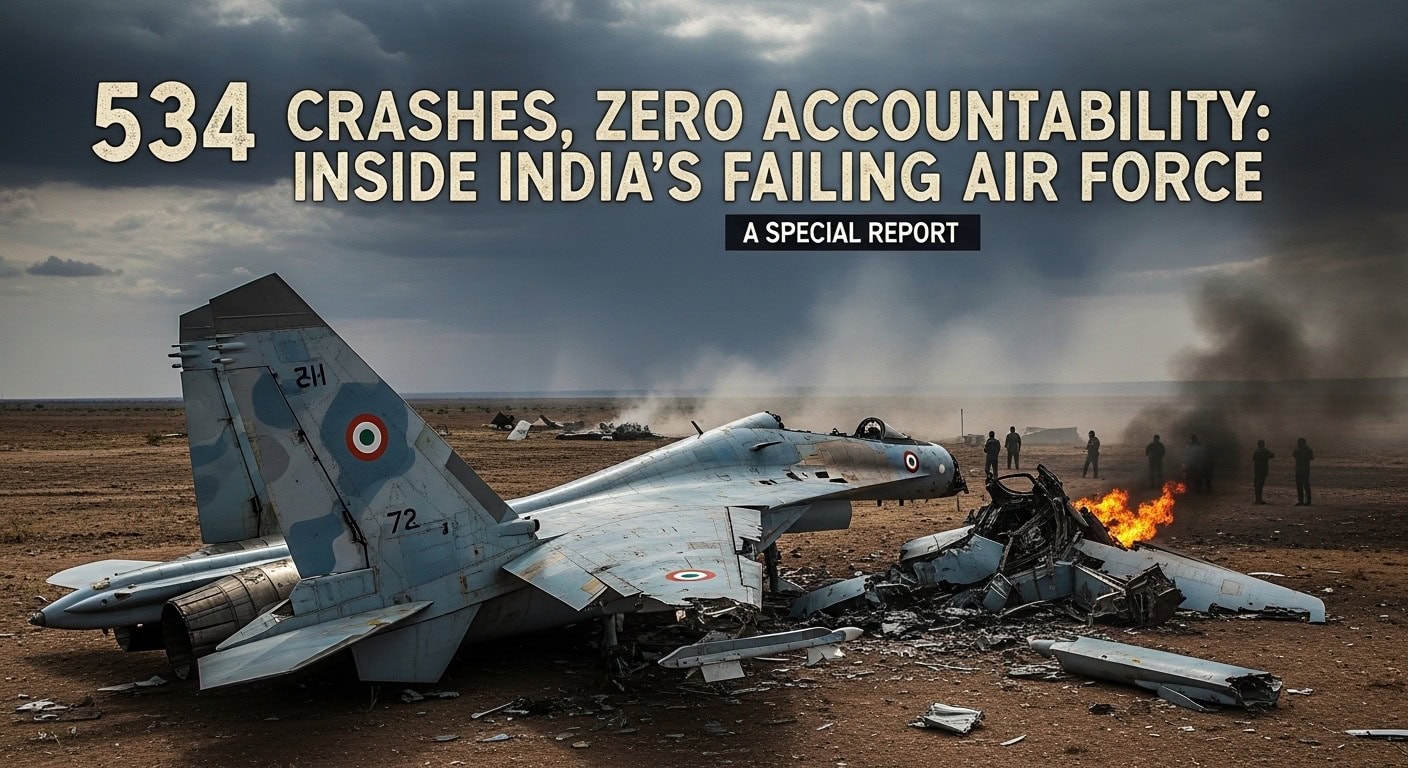
Let me be honest about something Indian Air Force will find deeply uncomfortable to read. Pakistan does not need to defeat the Indian Air Force. The Indian Air Force is doing that job itself, with impressive dedication and at extraordinary public expense.
On the night of March 5, 2026, two men strapped themselves into a Su-30 MKI at Jorhat airbase in Assam and took off into the dark. Squadron Leader Anuj had a family. Flight Lieutenant Purvesh Duragkar had a family. They had trained for years, sacrificed for years, believed in the institution they served. At 7:42 pm their aircraft vanished from radar. By the time search teams reached the forested hills of Karbi Anglong, there was nothing left to save. Neither man had ejected. Neither had even had the seconds required to try. They were on a training mission. There was no war that night. There was no enemy waiting in that sky. There was only the Indian Air Force, and the dark, and two men who took off and did not come home. They never do. That is precisely the point.
In the last 30 years, the Indian Air Force has lost 534 aircraft and 152 pilots. The overwhelming majority were not shot down by any adversary. They were destroyed by the IAF itself, through institutional incompetence, aging fleets flown past their limits, and a safety culture that has never been held to account. Yes, Pakistan shot down Indian aircraft, twice in recent memory and both times humiliatingly. In February 2019, following the Balakot airstrikes, Pakistani air defences downed an IAF MiG-21 and captured its pilot, Wing Commander Abhinandan Varthaman, an episode that exposed exactly how outmatched India’s aging fleet was in a real engagement. Then in May 2025, during Operation Sindoor, Pakistan shot down multiple Indian aircraft in a single engagement, delivering the most embarrassing aerial defeat the IAF has suffered in decades and doing so in full view of the world. Those combat losses at Pakistani hands are documented, confirmed and deeply damaging to India’s claims of air superiority. But even combined, they remain a fraction of the total destruction. The staggering bulk of 534 destroyed aircraft and 152 dead pilots belongs entirely to the IAF itself, to crashes in training, to jets flown decades past retirement, to mid-air collisions in their own airspace, to a friendly fire incident the morning after Balakot that killed six of their own men, to an institution that has perfected the art of destroying itself without any outside assistance. Pakistan did not need to build a perfect air force to threaten India. India’s air force has been haemorrhaging strength on its own for forty years. Pakistan simply accelerated what the IAF was already doing to itself.
The fleet-by-fleet destruction record is worth reading in full because the IAF’s defenders never will. Over 400 MiG-21s crashed in Indian service, killing more than 200 pilots, flown for six decades past their designed lifespan. Over 50 SEPECAT Jaguars crashed, a British and French design retired by the UK in 2007, by France in 2005, by Oman, Ecuador and Nigeria years ago, yet somehow still flying IAF sorties in 2026 and still scheduled to fly until 2035. Fifteen Mirage-2000s crashed. More than 25 MiG-29s crashed. Thirteen Su-30 MKIs destroyed since 2002, at $65 million each, totalling $845 million in that single type alone without a single enemy involved. The HAL Tejas LCA, India’s domestically built pride and the centrepiece of its Make in India defence ambition, has crashed three times since 2023. The brand new aircraft is already crashing. The excuse of aging Soviet jets has expired. What remains is institutional failure with no expiry date.
In 2025, four Indian Air Force pilots left for work and never came home. Their names are not famous. Their faces did not trend on Indian television. Seven aircraft were lost across that single year: three Jaguars, a Mirage-2000, a Tejas, an AN-32 transport and a PC-7 trainer. Each one of those aircraft had people inside it. Each loss produced a family that will mark that date on a calendar for the rest of their lives. One of those losses happened not over some remote forest or desert training range but on a live international stage in Dubai, in November 2025, in front of the entire global defence establishment. Wing Commander Namansh Syal was there to make India look capable. He was there because his government wanted the world to buy the Tejas. He climbed into that cockpit representing his country, his service and everything India claimed its domestic aerospace industry had achieved. The aircraft killed him in public. The year ended. The count did not. March 5, 2026 simply picked up where 2025 left off. The aircraft India wanted to export killed its own pilot in public. In April 2019, the morning after India’s celebrated Balakot airstrikes, an IAF Mi-17 helicopter was shot down over Budgam in Kashmir by India’s own surface-to-air missile system. Friendly fire confirmed. Six personnel killed. No commanding officer was publicly held accountable. The same institution that demanded international recognition for Balakot shot down its own helicopter the following morning and faced zero consequences. That is not a military. That is a pattern.
India’s defence budget for 2025 to 2026 is $78.57 billion, a 9.5 percent increase, making India the third largest defence spender on Earth behind only the United States and China. The aircraft and aero engines budget alone received $5.62 billion, a 21 percent year-on-year increase. The IAF’s capital modernisation budget has grown 86 percent since 2015. Yet the IAF is currently spending $156 million ordering 12 additional Su-30 MKIs not for fleet expansion but for replacement, specifically to replenish jets it destroyed in peacetime crashes. India is not building a stronger air force. It is paying twice for the same aircraft: once when inducted and once after the IAF destroys it in training. The taxpayer funds the jet. The IAF crashes it. The taxpayer funds the replacement. The pilot pays with his life. The Court of Inquiry is classified. The cycle repeats without interruption and without consequence.
The IAF currently operates 31 fighter squadrons against a sanctioned strength of 42. It would enter any two-front conflict at less than 75 percent of its authorised strength. It has lost the equivalent of 14 fighter squadrons to peacetime crashes while simultaneously operating 11 fewer squadrons than its own doctrine requires. This is the force that is supposed to threaten Pakistan on two fronts simultaneously.
Pakistan does not need propaganda to make this argument. The data is Indian. The sources are Indian. The Right to Information filings, the accident databases, the parliamentary questions, the CAG audit reports, the IAF’s own social media posts announcing each successive crash and offering condolences to each successive family: all Indian, all public, all damning.
