


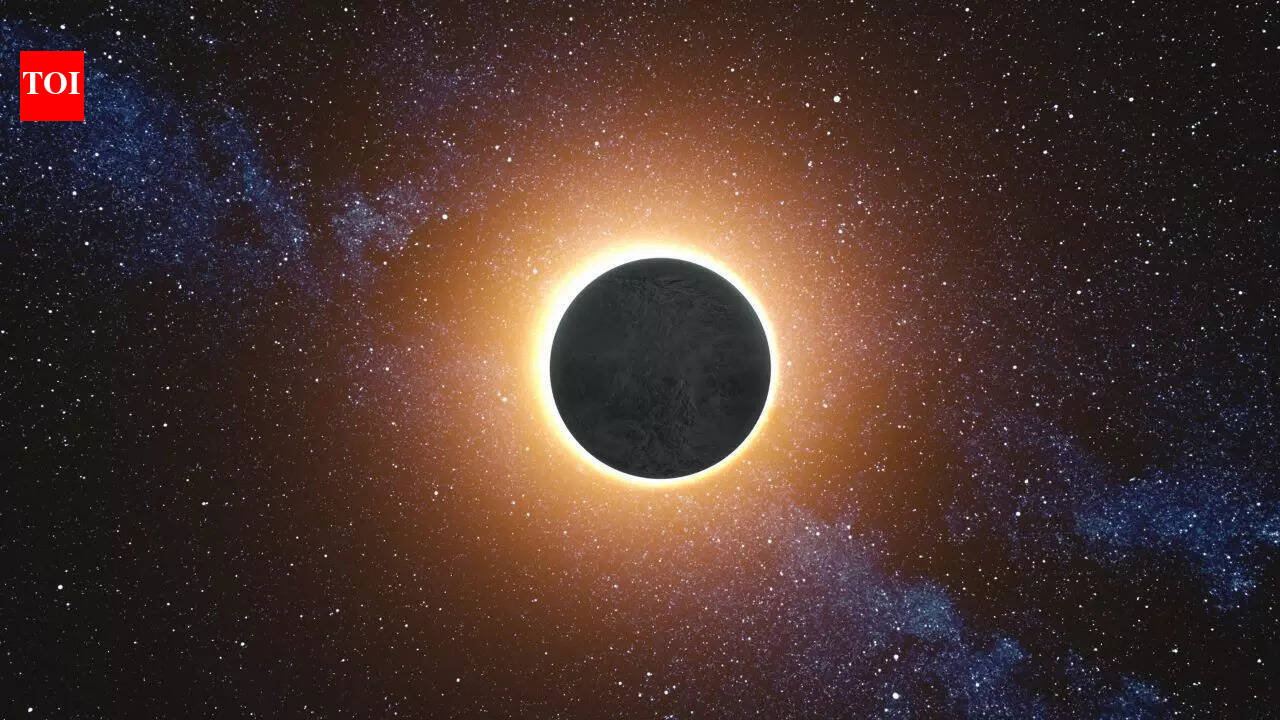
The annular or “Ring of Fire” solar eclipse will happen today, February 17, 2026. This celestial event will get a lot of attention around the world, but it won’t be visible from India. Because solar eclipses are talked about a lot and people often think they can see them from anywhere, this can be confusing for readers. In fact, whether or not an eclipse can be seen from a certain country depends on the exact positions of the Earth, Moon, and Sun in space.NASA says that solar eclipses only happen in certain places. Even if the Sun and Moon are perfectly aligned, the Moon’s shadow only covers a small part of the Earth’s surface. You can’t see the eclipse from anywhere that is outside the Moon’s shadow path.The Moon’s shadow will cover parts of the southern hemisphere, including Antarctica and nearby ocean areas, during today’s solar eclipse. India, which lies far north of this path, will be completely outside the eclipse’s visibility zone. This has nothing to do with weather, pollution, or regional conditions. It is purely the result of orbital positions and angles in the orbit.
What determines whether an eclipse is visible
The Moon moves between the Earth and the Sun during a solar eclipse. But according to NASA, this alignment alone isn’t enough for the eclipse to be seen from all over the world.The Moon makes two kinds of shadows:
- Umbra: the darkest shadow, where the Sun is totally blocked
- Penumbra: the lighter shadow where the Sun is only partially blocked.
The eclipse can only be seen in areas that are in these shadows. There is no eclipse at all in places that are not in these shadow zones.
The narrow path of the Moon’s shadow
The Moon is much smaller than Earth, so its shadow covers only a small portion of the planet at any given time. According to NASA, the path where an eclipse is visible can be just a few thousand kilometres wide.This narrow path is why solar eclipses are rare for any single location. Even though eclipses occur somewhere on Earth almost every year, most places see them only occasionally.
Where the first solar eclipse of 2026 will occur
According to NASA’s official eclipse maps, the annular solar eclipse on February 17, 2026, will have its central path over Antarctica and the surrounding southern oceans. Only regions within this narrow belt will see the full “Ring of Fire.”Partial visibility will extend to some areas in the southern hemisphere, but large parts of the world, including India, will be outside even the partial shadow.
Why the solar eclipse today will not be visible in India
According to NASA’s global visibility charts, India lies far north of the Moon’s shadow path for this eclipse. At the time the eclipse occurs, the Sun will either be below the horizon for India or positioned in a way that the Moon’s shadow does not touch the region at all.This means:
- No annular eclipse
- No partial eclipse
- No observable eclipse of any kind from India
This outcome is purely due to Earth’s curvature and the direction in which the Moon’s shadow moves.
Role of Earth’s curvature and rotation
The Earth is not flat; it is a sphere. According to NASA’s explanation of how solar eclipses work, the Moon casts its shadow onto only a part of the Earth’s surface during an eclipse, so locations on the opposite side of the planet or outside the shadow path cannot see the event. You must be on the daytime side of the Earth and within the Moon’s shadow to observe the eclipse.Also, the rotation of the Earth changes which parts of the Earth are facing the Sun during the eclipse. The eclipse won’t be visible from a place that is turned away from the Sun during the event.
Why does this have nothing to do with beliefs or predictions
NASA and the European Space Agency (ESA) both say that eclipses are predictable astronomical events that happen because of gravity and the motion of objects in space. Visibility depends only on geometry and timing.There is no scientific basis for linking eclipse visibility to regional effects or outcomes. If a country does not fall within the Moon’s shadow, it simply does not see the eclipse.
