


Last Updated:
From ancient Tilgul Poli to modern chikki bites, chefs Vikram Debnath and Somnath Porel explore the cultural wisdom, seasonal intelligence, and enduring relevance of til–gur



Makar Sankranti sweetness, til–gur that warms the season and the spirit.
There is a quiet intelligence in til–gur that modern kitchens often overlook. Long before festive food became performative or indulgent, sesame and jaggery existed as a seasonal language, one that spoke of warmth, restraint, and balance. Exchanged during Makar Sankranti with the phrase “Til-gul ghya, god god bola,” it wasn’t merely a sweet offering, but a social contract: accept sweetness, speak gently, begin again.
Chef Vikram Debnath, Executive Chef, Suka Brew and Kitchen, sees til–gur as one of India’s most honest culinary traditions. It arrives, he says, exactly when the body needs it most. Sesame, with its warming ushna quality, strengthens joints and counters winter dryness, while jaggery supports digestion, immunity, and mineral replenishment. In a season marked by cold mornings and post-harvest fatigue, til–gur was never indulgence, it was nourishment with intention. The symbolism followed the science, not the other way around.
This wisdom is especially evident in Maharashtra’s nearly forgotten Tilgul Poli. Before laddoos and chikkis became dominant Sankranti symbols, rural homes particularly in Vidarbha and Marathwada prepared this sesame–jaggery stuffed flatbread as a sustaining winter meal. It wasn’t festive sugar; it was slow energy. Shared during Haldi–Kunku, the poli symbolised warmth, fertility, and continuity. Its bread-like form mattered, it was designed to feed, fortify, and carry warmth through long working days.
In an era when celebration often means excess, this restraint feels radical. As Chef Debnath observes, traditional festive foods were never arbitrary. Ghee enhanced absorption, sesame fortified the body, jaggery restored balance. What we now rebrand as “superfoods” were once simply seasonal commonsense.
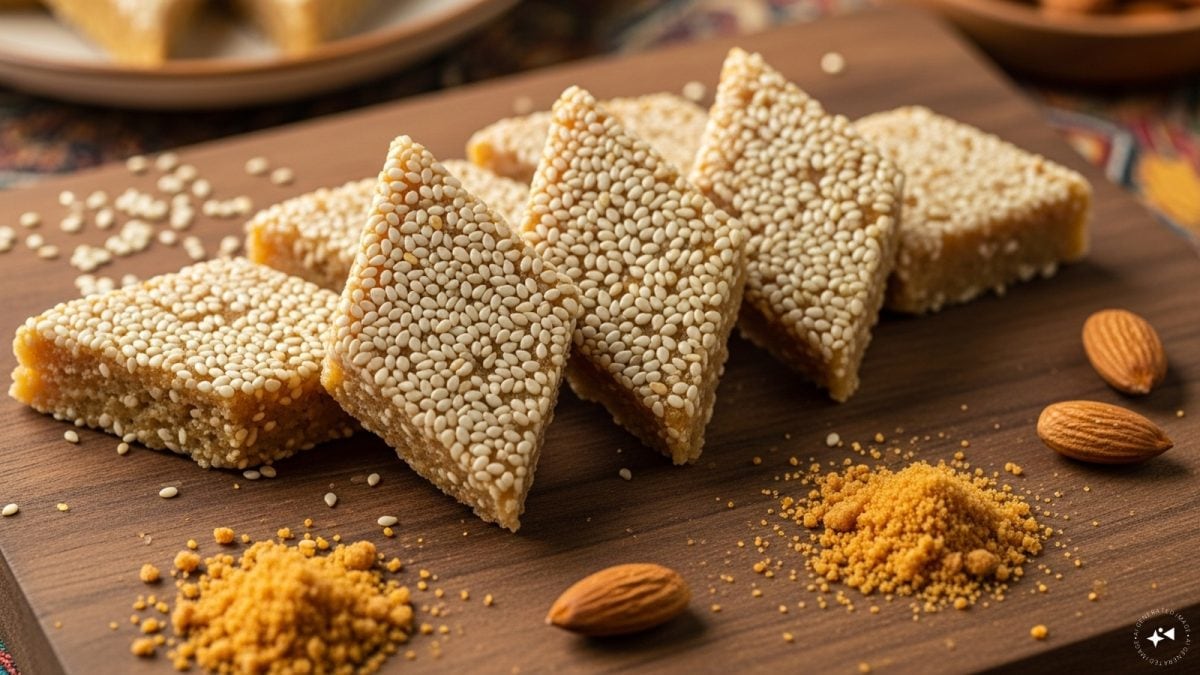
This same philosophy guides Chef Somnath Porel, Executive Chef, Elements by Rosetta, Varca, who approaches til–gur not as nostalgia but as a living culinary vocabulary. His Gur–Til & Orange Zest Chikki Bites honour Sankranti’s essence while speaking to contemporary sensibilities. Citrus zest brightens jaggery’s depth, black sesame adds nuttiness and visual contrast, and the refined, bite-sized format allows the sweet to move seamlessly into modern hospitality spaces from welcome amenities to curated festive hampers.
For Chef Porel, reinterpretation is not reinvention but respect. Tradition survives, he believes, when it adapts without losing meaning. The soul of til–gur remains intact; only its expression evolves.
What gives til–gur its enduring relevance is not sentiment, but alignment. It understands its season, nutritionally, emotionally, and culturally. It encourages warmth in the body, sweetness in speech, and moderation in celebration. In a world of year-round abundance and processed indulgence, til–gur remains a reminder that true luxury lies in timing, simplicity, and intention.
Tilgul Poli (Chef Vikram Debnath, Suka Brew and Kitchen)
Ingredients (Makes 6–8 polis)
Whole wheat flour or jowar flour – 2 cups
White sesame seeds – ¾ cup
Jaggery (grated or powdered) – ¾ cup
Ghee – 2 tbsp + extra for roasting
Cardamom powder – ½ tsp
Warm water – as required
A pinch of salt
Method
Dry-roast sesame seeds on low heat until aromatic. Cool slightly and coarsely grind.
Mix ground sesame with jaggery, cardamom, and 1 tbsp ghee to form a soft filling.
Combine flour and salt; add warm water gradually to make a soft dough. Rest for 15–20 minutes.
Divide dough into balls, stuff with filling, seal, and gently roll into medium-thick flatbreads.
Roast on a hot tawa, applying ghee on both sides, until evenly cooked and golden.
Serve warm with a little extra ghee.
Gur–Til & Orange Zest Chikki Bites (Chef Somnath Porel, Elements by Rosetta, Varca)
Ingredients
White sesame seeds (lightly crushed) – ¾ cup
Black sesame seeds – ¼ cup
Organic jaggery (grated) – ¾ cup
Roasted almonds (sliced) – 2 tbsp
Roasted peanuts (crushed) – 2 tbsp
Ghee – 1 tbsp
Fresh orange zest – ½ tsp
Green cardamom powder – ¼ tsp
Sea salt – ¼ tsp
Method
Dry-roast white and black sesame seeds separately until aromatic; keep warm.
Melt jaggery with ghee on low heat until glossy and just sticky (soft-ball stage).
Add sesame seeds, nuts, cardamom, orange zest, and sea salt; mix swiftly.
Spread thin between parchment sheets.
Cut into small discs while warm; cool completely and store airtight.
January 13, 2026, 09:42 IST
