


Last Updated:
Long before Yoga became about flexibility and fitness, Yoga masters believed good health was a responsibility—to oneself, to one’s evolution, and to future generations
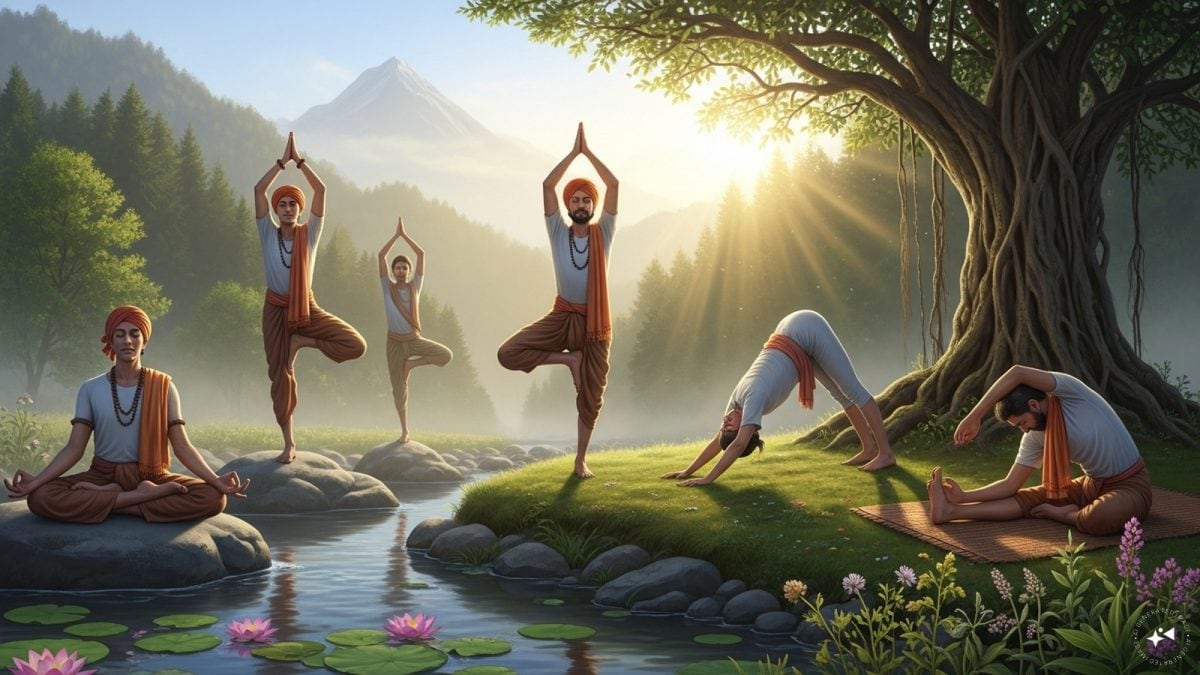
The ancient yogis had a far deeper idea of legacy: they considered health itself a form of inheritance. (AI-Generated Image)

I recently came across a beautiful line that captures the meaning of legacy: “Legacy is not leaving something behind for people. It’s leaving something behind in people.” Attributed to Peter Strople, it is usually interpreted as passing on values and character rather than wealth or property.
The ancient yogis, however, had a far deeper idea of legacy: they considered health itself a form of inheritance.
A healthy body protected you from disease and extended your lifespan, yes—but it also shaped the health your children were born with. Yoga believed, much before genetics entered the scene, that health was important—a responsibility you owed to yourself, and to posterity.
Yoga education, in that sense, was intended to have a far larger role than flexibility, stress relief and mindfulness. It was a long-term investment, both personal and for future generations.
On the personal front, good health additionally bought you time—time that was needed to understand yourself and to reach life’s final aim.
Yoga’s Lofty Health Ideals Explained Simply
Unlike other philosophical systems that view health as irrelevant to spiritual experience, classical Yoga—from its earliest teachings in texts by Yajnavalkya, Svatmarama and others—placed a high value on health and physical education.
Pioneering Yoga teacher Shri Yogendra, founder of The Yoga Institute, offers some rare insights into this. In his book Yoga Asanas Simplified, he outlines the health goals of classical Yoga:
Rogachikitsa — removal of ill-health
Arogya — building positive health
Swatah-Vikarakshamata — auto-immunisation (building the body’s natural self-protective capacity). Think of it as strengthening your system the way regular sleep or sunlight does.
Deha-shuddhi — biological purification or overall internal balance
These may sound philosophical, but they translate into everyday wellbeing: being disease-free, building resilience, and keeping internal systems stable.
According to Shri Yogendra, they culminate in three major outcomes:
Chirayu — longevity
Chirayauvana — ‘eternal youth’ or sustained vitality
Nadi-shuddhi — higher nervous control
Higher nervous control positively influenced mental hygiene (chitta shuddhi) and, eventually, moral behavior (yogachara).
These gains—cumulatively, and often unbeknownst to the practitioner—helped them attain the various stages of meditation (samyama), and then samadhi, the final objective of Yoga.
Yoga Physical Education & Good Health
It is striking that the ancient seers, who cared little for the ‘earthly’ body for its own sake, also emphasised good health. They believed health was a necessity for self-assertion, self-expression and self-realisation—the real fundamentals for which we live.
Shri Yogendra points out that physical training was emphasised in yogic health perspectives, which considered the “wholeness of man”.
Centuries ago, ancient yogis had concluded that physical training affects not only the motor centres, but also parts of the brain, especially those governing mental processes. The body and mind were considered two sides of one human system, which neuroscience confirms now.
Incidentally, Yoga regards good health as man’s ‘natural privilege’. Its view is radical: right living makes it easier to stay well than to be sick.
Good Health Extends Lifespan—So One Can Complete Evolution Within One Lifetime
Beyond mental purity and control, and moral and spiritual progress, the ancient yogis believed that the student should also aim to extend earthly existence—achieved through Yoga by defying old age, and even death.
This would give the practitioner the necessary time to complete one’s course of psychic and spiritual evolution during one lifetime.
Physical Immunity & Health as Inheritance
Yoga insists that it is in the interest of human evolution—physical, mental, moral, spiritual—that a strong biological link is maintained across generations. For this, the body has to be made as healthy as possible.
Without conscious physical education, this inheritance can weaken. Not just the individual but the race, Yoga maintains, would suffer gradual deterioration. It emphasises that it is within our power to conserve — or to dissipate — our health and the fortune of inheritance we may have received.
Seen this way, Yoga’s framework treats health as both empowerment at a personal level and a generational responsibility. These are Yoga’s health ideals in relation to physical education. And hence, the elaborate program with its emphasis on discipline.
(The author is a journalist, cancer survivor and certified yoga teacher. She can be reached at swatikamal@gmail.com)
 Click here to add News18 as your preferred news source on Google.
 December 13, 2025, 09:29 IST
